Showing posts with label Panchayat. Show all posts

Monday, July 07, 2014

The Day I Couldn't Urinate: Reporting Sanitation Issues In India

It's well known by now: a majority of Indians do not have a toilet. They urinate and defecate in the open. They include men, women, children and adolescent girls. It’s a shame. It's indignity epitomized. But do you ever think what does a journalist who covers sanitation issues in India go through? Well, it’s the same shame and indignity. Let me tell you about one day - JUST ONE OF THE MANY DAYS - that I had to experience this.

I was in Handitola village in Rajnandgaon district of Chhattisgarh state in central India. With me was a local woman social activist. We arrived at the house of the village council head (locally known as 'sarpanch'). As it turned out, she was away from home, and would return in another half an hour. Her son and daughter-in-law were at home and they requested us to sit. They also offered to make tea for us.
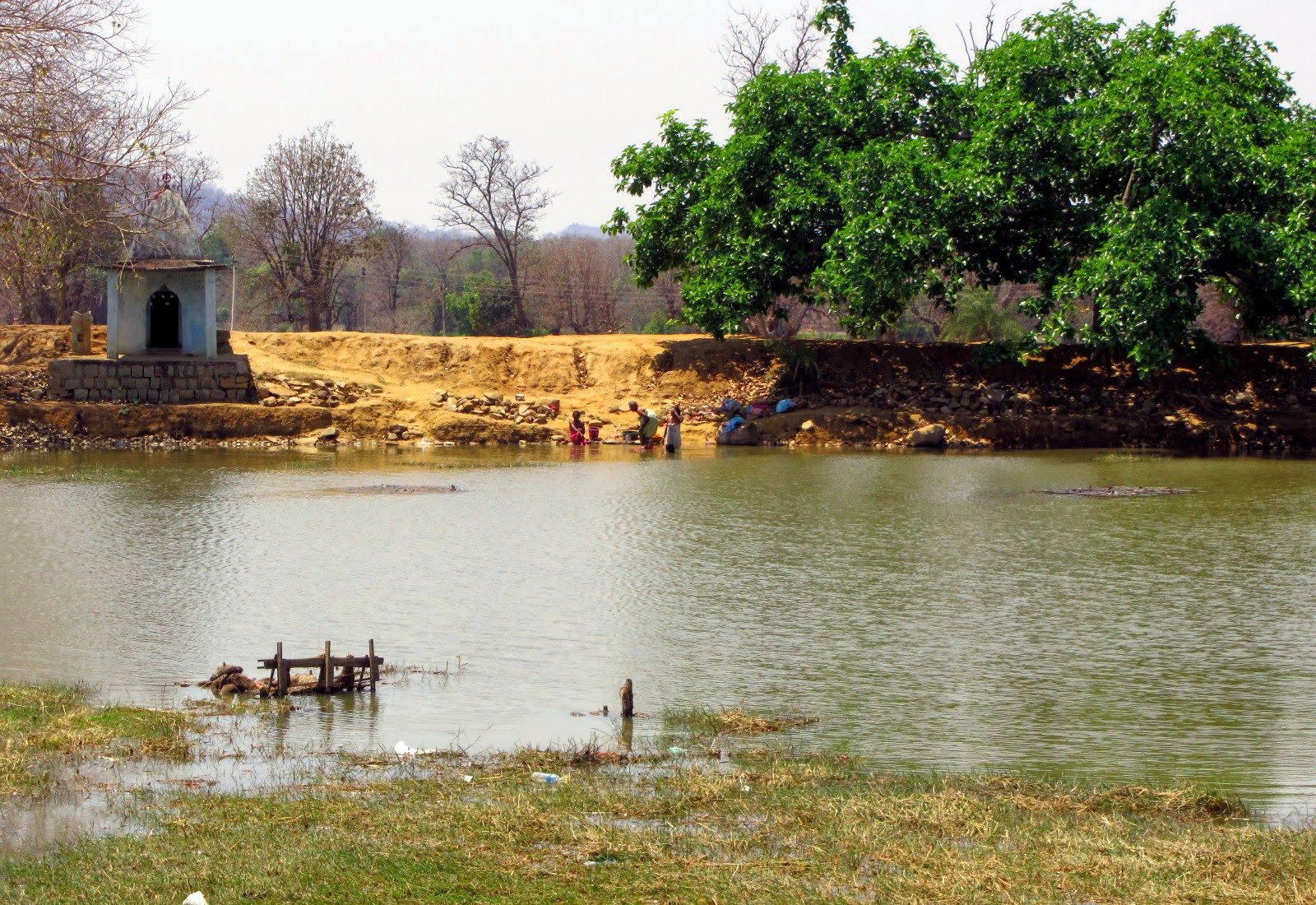
A typical community owned pond in a village. Villagers bathe there, as do - often times -their cattle, they wash their clothes and carry home pitchers of water to wash utensils and cook. The banks are usually where they squat on to relieve themselves.The tiny structure is the shrine of the patron god of the village. 


We were waiting. The house had a neat courtyard, 3 rooms, a nice little veranda and a cowshed. I walked around a bit, peeped here, peeped there. I could see no toilet.

We had eaten a rather large breakfast in the morning at Bhan Didi’s (the activist) place because it was going to be a long day, and I also drank a large glass of chai. Now, I was feeling the pressure on my bladder. I needed to go, urinate. But, there was no place to go.

Monday, January 16, 2012

Inspiration in the land of despair - A story re-told

The following is my article that has just been published in World Pulse - an action media powered by women of 185 countries. The article is my 2nd assignment as a Voice of the Future Correspondent - an honor I received in Nov'2011 by World Pulse. You can also read it here. Why am I sharing this here? Because, it is not everyday that you get to hear that a landless and tribal woman, despite being caught in between the frying pan and burning pyre (the Maoists and the Army), is trying to do pull a community out of poverty, discrimination and injustice. 


Me and my muse: with Sukhantibai, the barefoot soldier who fights social injustice with the weapons she has: strong will and honesty.
November’2005. In Handitola- a remote village in central India, people were faced with a horrific situation: a young Dalit (a marginalized community) man had hung himself and the body was on the verge of decomposing. But nobody dared go near him. They all had their reasons: for some, the boy was an ‘untouchable’, while others were plain scared. Then, a woman of 50 came up, with a sickle in her hand. She stood upon a stool, and, as the whole village stared in fear and awe, cut the rope and lowered the body. Next week, in a meeting in which they had to decide who would be their ‘Sarpanch’ - the head of the village council, everyone voted for this woman – the most courageous one among them. And that is how Sukhantibai - a Gond (a primitive tribe) woman, became the ‘Sarpanch’.

In The Line Of Fire

7 years later, I am meeting Sukhantibai today. I have traveled for 3 days to reach her village in Rajnandgan – one of the 78 districts identified by the government of India as ‘Maoist affected,’ meaning places that have borne maximum brunt of the Government vs Maoists (communists) armed conflict.

On my way, I have been feeling the suspicious glare of several people, and, since I reached the district, my mobile phone has gone off the network.

Sunday, January 08, 2012

Chhattisgarh: How Does a Woman Sarpanch Work in Bastar?

The participation of Indian women in the political process, especially at the hyperlocal level, has been on the rise since reservation of  33% of seats in the village councils came into force. In the tribal belt of Bastar, women actually have 50% seats reserved for them. But, with the Government Vs Maoist conflict raging, how is that reservation helping? How does a woman village head work?
Kalavati and I: It would be easy to criticize this Sarpanch for not doing enough, but it would  be wiser to try to understand the reasons that force this under-performance
To find the answer, I have met 23 women Sarpanch (head of the the village council) in Bastar, 15 of them are in forest areas where the Maoist activists are very active. Let me share the story of Kalavati Salam - the sarpanch of one such village panchayat.

Saturday, September 17, 2011

The Vanishing Women


A lot has been written about ‘pati panchayat’ of India where elected women of village councils (panchayat) across India are made to act like rubber stamps while their husbands (pati) call the shots.


But the system prevails even in areas of India that still do not have the Panchayat system. Take Meghalaya’s Garo Hills for example.


Garo Hills is home to the Garos – one of the 3 leading tribes of Meghalaya (Garo,Khasi, and Jaintia). Garo Society is governed by matrilineal laws of succession and inheritance. Inheritance and descent, therefore,  pass on from one generation of women to another. Usually it’s the youngest daughter who assumes the role of a family and the clan. Known as Nokma, she manages the property of the entire clan often consisting of an entire village.

But these days, all across Garo hills, it has become a common sight where the husband of a Nokma takes all the decisions, thus turning the woman into a puppet.