Wednesday, September 02, 2015

Water water everywhere: Not a farmer to spot!

I just returned from the World Water Week in Stockholm, the Swedish capital.

Organized by the Stockholm International Water Institute (SIWI), the week-long event was focusing on Water and it's intricate and crucial link to development worldwide. It was, as I learned, the 25th year of the event.
The Prime Minister of Sweden addressing the participants at the inaugural session of the World Water Week.

As you would expect in a global event like this, there were participants from different walks of development and water: scientists, finance experts, engineers, political leaders and activists and media personnel like me. There were talks of innovation, technology, finance, aid, collaboration, policy, regulation, transparency and so on. We also heard some country heads talk about some of the burning issues of our time: climate change, disasters, conflict and the migrant influx.

But there was something crucial that was missing: the voice of the farmer. And it came as a surprise - of a rather shocking nature. After all, this was an event discussing water and it's role in the world's development, especially the Sustainable Development Goals which are soon to replace the Millennium Development Goals.


Food production and food security are always the key to  a sustainable world. And everyone was talking of this - except the food grower himself. Irony much?

Wednesday, August 12, 2015

Youth Climate Leadership: Lets Also Mind the Sharks

A couple of weeks back, I was in Singapore's United World College of South East Asia, listening to a roomful of young men and women talking passionately about climate change. As they spoke, a sharp, almost painful, thought struck my mind: "are we serious about transformative leadership here, or, is this just another ritualistic act?"

Now, why did I think of this? A little background might help. 

The youths I heard were from the ASEAN member states (If you didn't know already, these are Singapore, Indonesia, Malaysia, Philippines, Brunei, Thailand, Vietnam, Cambodia, Laos and Myanmar) and they were here to take part in ASEAN Power Shift 2015 - a 3-day  training workshop on climate change and the  upcoming Paris Climate Conference (COP 21).
Youths at ASEAN Power Shift 2015. Photo credit: Young NTUC

It was a pretty diverse group:: some were graduate students in a university while others were still in junior high schools. Some already had a lot of knowledge about climate change and erratic weather, while others only had a faint idea of what it might be. And, as I found out later, only about half of  them lived in cities, with 24x7 internet access while  the other half lived in the provinces with little or no access to digital connectivity. 

Yet here they were - bound by a common thread: concern for a fast degrading environment in their respective countries and a strong wish to set it right

Wednesday, July 22, 2015

Smart Sanitation: Shimla Sets an Example

A couple of days back, I read this really great news about Shimla - a hill station in the north of India: the popular tourist hub is aiming for smart sanitation by installing hundreds of E-toilets.

Now, what is E-toilet? Well, its an unmanned toilet which cleans itself, one that's based on a sensor-based technology.

Let me explain a little more.  As you see in the photo below, the toilet has a locked door. Now, when you want to use it, you insert a coin to open the door. As the door opens, the toilet's sensor-based light system is automatically turns on - pretty much like the way your ATM teller machine turns on when you swipe your card.
An E-toilet. Courtesy: Eram Scientific

And, just like the ATM machine, the toilet also will direct you with audio commands. This means, you will be directed on how to use the toilet.

To conserve water, the toilets are programmed to flush 1.5 liter of water after three minutes of usage and 4.5 liters if the usage is longer. This “smart” toilet also washes the platform by itself after every five or 10 persons use the toilet. An instructional note is pasted outside the toilet to make the user familiar with the functioning of this toilet. The auto flush goes off on its own and uses just the right amount of water that is needed - not less and not more.

 But why is Shimla adopting e-toilet, instead of building more of the old-style conventional toilets?

Sunday, June 07, 2015

Rohingya Refugees: Vulnerable on the sea, not much better on land!

You probably have been reading about them these past few days or watching them on TV - the Rohingya refugees of Myanmar who were chased out of their homeland and now floating around the ocean on boats with no food, no water and nowhere to go. Hundreds of them have already died already while death stares at hundreds of others.

Truth is, hunger and misery are also constant companions of even those Rohingyas who live on the land. I met some of them in Hyderabad city of India. Sharing here some of the images that, several months later, still haunt me!


The Rohingya refugees arrived in India from Bangladesh. For some, it has been a few weeks, while some have been here since 2012. Each one of them has a horrific story to share: beaten, tortured, forced to leave home, watching their near ones being murdered and their homes being burned down.

Tuesday, June 02, 2015

Toilets: teaching is better than talking!

Sometime in April, I met Roopa, an extraordinary young woman, in a village called Nagenhalli in south-west India. She was smart, friendly, warm and very pretty. But what made me call her extraordinary is this: the woman had built a toilet, all by herself.

Roopa's toilet
Now, before I tell you how she built the toilet, let me share the 'why':

Roopa is a Dalit and her mother is a former temple sex slave. All the men from her village wanted Roopa to also become a sex slave and, as she reached puberty, they began to look at her with lust. So, one day Roopa's mother ran away to another village miles away from her  own, taking along her 6 children.

But in their new village, women and girls were often sexually harassed and assaulted by men from
'higher castes'. Most of these assaults took place when girls and women went to relieve themselves in the open.

Tuesday, May 05, 2015

Death by coal: our women deserve better

A few weeks ago, I met Minjamma, a woman in her 50s, in Kariganur neighborhood of Hospet town in southern India's Karnataka. And it was a terrible experience.

It was late afternoon and Minjamma was getting ready to cook dinner. She brought out an iron cookstove, placed that in the lane next to her home and lit it. 


Within minutes, a big column of thick, brown, foul-smelling smoke rose and engulfed the whole lane.  My eyes, nose and throat began to burn and water and I found myself nauseated and struggling to breathe. Before I could black out, I ran - to the end of the lane, about 500 meters from Minjamma's house. But from there,  I could still see her bent over the stove, poking it and coughing loudly.

I was wondering when it would the smoke clear up, so I could return to Minjamma's home. However, soon  women from every house in the neighborhood began to light their stoves. The smoke grew thicker, uglier and the air became so smelly, I clutched my chest trying hard to breathe and hoping I wouldn't just drop dead.

 A few teenage girls came out of their homes and sat beside me, asking if I was ok and offered me water.  Once I was able to breathe easy, my first question was what was this horrible thing burning in every cookstove. The answer came as a shock: they were burning coal. 
Real coal.

Monday, April 20, 2015

Clean India: There's No Glory in Being Stupid!

Last week I was in north Karnataka. One of the biggest attractions there is the dam over river Tungabhadra which provides water to several districts of north Karnataka and neighboring Andhra Pradesh.  I was told that this is a must-see and they were right: the dam was truly beautiful.

          
But every time I crossed over one of the branch canals of the dam, I saw it littered with trash. So, there were people bathing, washing and drawing water from the canals for their other needs while also throwing their trash in!  How disgusting!

I returned from the trip yesterday and saw the trash collector with her van. The woman -  employed by the  municipality - comes 3 times in a week and collects the trash. We have to pay her 50 rupees which is actually less than what a packet of cigarettes (about 90 rupees) or, a large bottle of Coke costs (80 rupees).

But every time the woman comes, she collects trash from only a few families in our lane. The reason? Others are not ready to pay her 50 rupees for trash disposal. And these are educated people from fairly well to do families!

So, how do they dispose their trash? Well, they go out in the evening with a bundle of trash ( a plastic bag) and throw it by the roadside. Sometimes, the trash collectors stop by and pick them up, sometimes they just rot there. Often, dogs tear them often, if they smell meat or fish.

Sunday, March 22, 2015

When Thirst Beats Education

A few weeks back, I was in a village along the border of Andhra Pradesh and Chhattisgarh where I met Sandhya Rani, a 10 year old. She was carrying a bamboo staff on her shoulder and , fastened to its ends, three aluminum vessels. In these vessels, she was going to carry water from a borewell for her family, along with her 7 year old sister Saundrya.

Their parents were working as migrant laborers in a city and the girls lived with their elderly grandmother.


I followed Rani from her house which was at the village' entrance to the borewell at the far end of the village. That was the only borwell in the village - the source of potable water for over 500 people.

Wednesday, March 18, 2015

Girls' Education: Lets Look Beyond Enrollment

I recently met Bharti, a bubbly 13 year old, at a children's shelter 110 km away from Hyderabad. She had been rescued a few of months ago, the staff at the shelter told me.

"Rescued from who and what? Traffickers? Abusive employers?" I wanted to know
The answer was, "from her own parents".


No, Bharti's parents were not abusive or trying to sell their daughter to someone. It's just that they often stopped her from going to school and took her to work in a farm instead.

Now this sounds quite trivial, doesn't it? After all, the parents are just making the girl miss a few days' school now and then, right?

Not quite.

Wednesday, December 31, 2014

2014 - a Year of Traveling and Story Telling

Time flies. 2014 too flew away! But it was a kind year. It gave me opportunities to tell the stories that I CARED FOR. And it also got me the greatest of recognitions! Shared here are some of those moments and some of the stories that I told.

January: Telling the story of the forest women

The first month of 2014 took me to the Eastern Ghat mountains of India, to villages that are home to several primitive  tribes including the Koyas and the Kondas whose livelihood depends on hunting and gathering herbs. 

Here, in the dense forest, I met women who are turning entrepreneurs, using renewable energy. They use solar powered driers to dry their herbs and are selling the herbs to a clientele that includes large corporate houses! Here is one of their stories.

Monday, December 29, 2014

10 Years After the Tsunami : How Are the Women?

10 years have passed since the devastating Tsunami happened.  How have things changed on the ground since then, especially for those who bore the brunt of that disaster? In this second part of my photo blog,  I am sharing few photographs of women in the coastal villages that I met.

 The most optimistic picture that I saw was this...


I met this woman - Shivapiriya - near the famous shore temple of Mahabalipuram. She was there with her sister, speaking to a relative on a cell phone. 10 years ago, she didn't have a cell. But today, if disaster strikes, Kavitha is confident that she can reach out someone- anyone -and call for help, no matter wherever she is. No technology alone cannot guarantee safety, not of the climatic kind, but it can sure decrease the level of helplessness, especially for a woman.

And the most depressing picture was this...

Friday, December 26, 2014

In Photos: Life After 10 Years of Tsunami - Part 1

It's been 10 years since the devastating Asian Tsunami happened. How have things changed on the ground since then, especially for those who bore the brunt of that disaster? To find the answer, I recently visited some villages along the east coast of India. Shared here are few glimpses of life I saw there.


 And now there's another shrine - The Tsunami Temple


The Tsunami in 2004 took a lot - lives, homes and assets included - but also gave something. This structure, for example, emerged out of  the sea  next to the famous shore temple of Mahabalipuram  and quickly gained popularity as the Tsunami Temple. Natarajan, a tourist guide told me, 'this is our latest attraction'  and then, "but you can't go there. It's too slippery".   Now, that's a fitting gift of a disaster!

"Tourism matters, tourists matter, we don't"


Prabhakar Sharma sells souvenirs on the beach. After the Tsunami in 2004, the government was quick to restore the Shore Temple of Mahabalipuram, he said. But,  for the owners of over 100 makeshift shops that were also destroyed by the tsunami, there hasn't been any compensation. A bitter Sharma told me this : "The govt invested well into restoring the temple and the facilities for the tourists. But we, the beach traders who sustain the tourists interests, were left to lick our  own wounds. We just didn't matter"

           A new trail of disasters

There is an alarming rate of erosion along the coast and every village has at least half a dozen houses that are in various stages of destruction.

Thursday, October 16, 2014

They said this: Take away messages from CBDCOP12

The 12th conference of the parties of the United Nations Convention on Biological Diversity (or CBD COP 12) began here in Pyeongchang, South Korea on 5th of October. Since then, I have met and had exclusive interviews with several leaders here. Each of them impressed me with their answers and especially their patience in explaining complicated issues in the most simple terms. You can read the news articles that I filed from the convention on the IPS news site. Sharing  here, below, are some of the statements from each of these leaders that I am calling my take home messages.

Braulio Ferreira de Souza Dias – Executive Secretary, Convention on Biological Diversity (CBD)


We now know what we need to do to prevent biodiversity loss and invasive species. We need to integrate biodiversity into our sustainable development.”


Ibrahim Thiaw – Deputy Director, UN Environmental Program (UNEP) 


"Hope that the member countries would really commit themselves to achieve the Aichi targets. It is a collective commitment that needs to be made. If you go back and don’t match your words with action at the national level, it’s not going to work"

Tuesday, October 14, 2014

Hunted Animals to Haunting Ebola: Nothing’s Too Far-fetched


A few months ago, when Ebola outbreak first began, many of us just didn’t care much. It was a strange disease happening in one part of world - West Africa to be precise -that was far away from us. And, so, we didn’t bother to connect to it at all.


Well, things have changed a lot since then, haven’t they? Ebola has gone out and beyond of West Africa, infecting, as we speak, 8,300people and claiming 4,033 lives in places including Europe (Spain) and the US. And it’s spreading. Suddenly we realize, nothing in this world is too unconnected. No place in this world is too far away. And, in this blog of mine, I want to also tell you that nothing is also too far-fetched either, especially when it comes to a crime and its effect on our lives.


Just before I began to write this, I spoke with some scientists  at the 12th Biological Diversity convention (CBDCOP12) who have been studying the link between biodiversity and infectious diseases. They are Catherine Machalaba, MPH,Health and Policy Program Coordinator  of the Eco Health Alliance in New York and  Anne-Helene Prieur Richard, executive director of the Paris-based biodiversity research institute ‘Diversitas’. I asked them to explain how destruction of biodiversity could also lead to the spread of Ebola virus globally. 

Before I get to their answers, let me remind you what we already know: The recent Ebola outbreak started where eating the meat of wild animals (popularly known as “bush meat”) has existed for a long time. Bat soup, Meat of monkeys and other apes are popular dishes in many countries including Guinea, Sierra Leone and Liberia. 

But, there is a lot of people also buy these animals for their body parts. As a result, a lot of hunting takes place because people want to make money by selling the animals – dead or alive. And it is with this rampant hunting that the threat of spread of a virus like Ebola also increases.

Wednesday, October 08, 2014

Ocean Acidification: Do We Give a Fish?

This week – and the next week – I am in Pyeong Chang – a mountain town in the Republic of Korea, covering the 12th Conference of Parties on Biological Diversity (CBD COP). Posting here my views on what’s happening at the venue.  You can also read my news articles from the COP here.

Two years ago, one morning I stood on the beach of  Calangute – a coastal town in western India’s Goa and watched rows of fishing boats returning to the shore. Each of these boats had, wrapped in a large net, the night’s harvest from the ocean. As the fishermen emptied their nets, the sand was instantly covered with a silver carpet of thousands of fish. ‘Blessed wealth of a benevolent sea god’– I remembered whispering to myself.


Today, I am reading a UN scientific report that shows that the blessing and wealth of the ocean is under severe threats, thanks to a rapidly rising level of acidification of the ocean water.

Friday, October 03, 2014

Building climate resilience: Unlock the technology


In 2012, I went to Inner Mongolia to see how local nomadic communities were fighting an advancing desert. I was very fascinated to see how they were building a green wall in the middle of a sandy land. It was then that I heard an expert from the United Nations Convention for Combating Desertification (UNCCD) say, ‘many countries, especially India, have so much of knowledge and technology in their labs. But little of that is reaching the people on the ground. We need to make that happen.”
Putting life back in lifeless sand. In Inner Mongolia, scientists and locals have worked hand in hand to make this miracle happen.
Two year later, today, at the 4th Asia Pacific Climate Change Adaptation Forum in Kuala Lumpur, I heard many experts expressing the same view again – a logical, practical and extremely timely expression.


One of them was Rajib Shaw, a professor of disaster and risk management at Kyoto University. 

Thursday, October 02, 2014

Gender-Inclusive Adaptation: Vanuatu Shows the Way

Have you ever been to, or, if you pardon my saying so, even heard of Vanuatu? I honestly hadn’t and actually had to search Wikipedia for help! And this is what I found: it’s a very small country on the pacific coast, next to Fiji and New Guinea. The population of the entire country is just 250,000 – which is smaller than some of our cities.

It was from this tiny, hard-to-find-on-the-map island nation that we heard one of the most powerful pieces of information on the 1st day of the 4th Asia Pacific Climate Change Adaptation Forum in Kuala Lumpur (APAN2014): the country is following a 50% reservation for women policy when it comes to negotiating climate change and also implementing climate change adaptation projects.

 
An areal view of Vanuatu


I was at a session on “gender sensitive adaptation” in Johar Keda auditorium of the Putra World Trade Center where the forum is taking place.

Saturday, September 20, 2014

Developing like Singapore? Go Beyond the Obvious!

This year, Singapore seems to have emerged as one of the most favored nations of Indian leaders. First, our foreign minister Sushma Swaraj visited Singapore. Soon after, Mamata Banerjee - the chief minister of West Bengal and Vasundhara Raje, chief minister of Rajasthan went there. Next in line was K Chandrasekhar Rao - the chief minister of Telangana - India's newest state. And then we saw the chief minister of Andhra Pradesh playing host to  Foreign Affairs minister of Singapore. Though they all went their own individual way, there was something common about these visits: woo Singapore to invest into and engage with the development process in their respective states.


As I follow these interactions, I wonder, has any of the dialogues ever moved beyond the obvious roads and ports?  Has any of our leaders thought of partnering with Singapore in areas where the country has failed the most : sanitation, water, hygiene and safety for women?

Thursday, July 24, 2014

Impact of my story: woman freed from forced laborer

Its a beautiful, beautiful day. You know why? Because, a woman forced laborer who I had recently reported about,  has just been set free by her employer. Here's the story of her release. You can also read it in the website of IPS News - the media outlet where my story had first appeared.
----------------------------------------------------------------------------------------------------------------------


The first time I met Sri Lakshmi, she was climbing a flight of stairs in a half-constructed building in the residential area of Vanasthalipuram, in the South Indian city of Hyderabad, carrying a stack of bricks on her head. She was a forced labourer, who received no payment for her work. That was in mid-April.

Last week, I met her again. This time, she was carrying something entirely different: a school bag that belonged to her four-year-old daughter Amlu. Lakshmi was a free citizen and Amlu was going to school for the first time.

Separating our two meetings is a story that was published by IPS entitled ‘No Choice but to Work Without Pay. It was this article that stirred action on the ground, paving the way for Lakshmi’s release.

Here is how it all happened:
Sri Lakshmi, a recently released forced labourer, and her four-year-old daughter Amlu. Credit: Stella Paul/IPS
Sri Lakshmi, a recently released forced labourer, and herfour-year-old daughter Amlu

Monday, July 07, 2014

The Day I Couldn't Urinate: Reporting Sanitation Issues In India

It's well known by now: a majority of Indians do not have a toilet. They urinate and defecate in the open. They include men, women, children and adolescent girls. It’s a shame. It's indignity epitomized. But do you ever think what does a journalist who covers sanitation issues in India go through? Well, it’s the same shame and indignity. Let me tell you about one day - JUST ONE OF THE MANY DAYS - that I had to experience this.

I was in Handitola village in Rajnandgaon district of Chhattisgarh state in central India. With me was a local woman social activist. We arrived at the house of the village council head (locally known as 'sarpanch'). As it turned out, she was away from home, and would return in another half an hour. Her son and daughter-in-law were at home and they requested us to sit. They also offered to make tea for us.
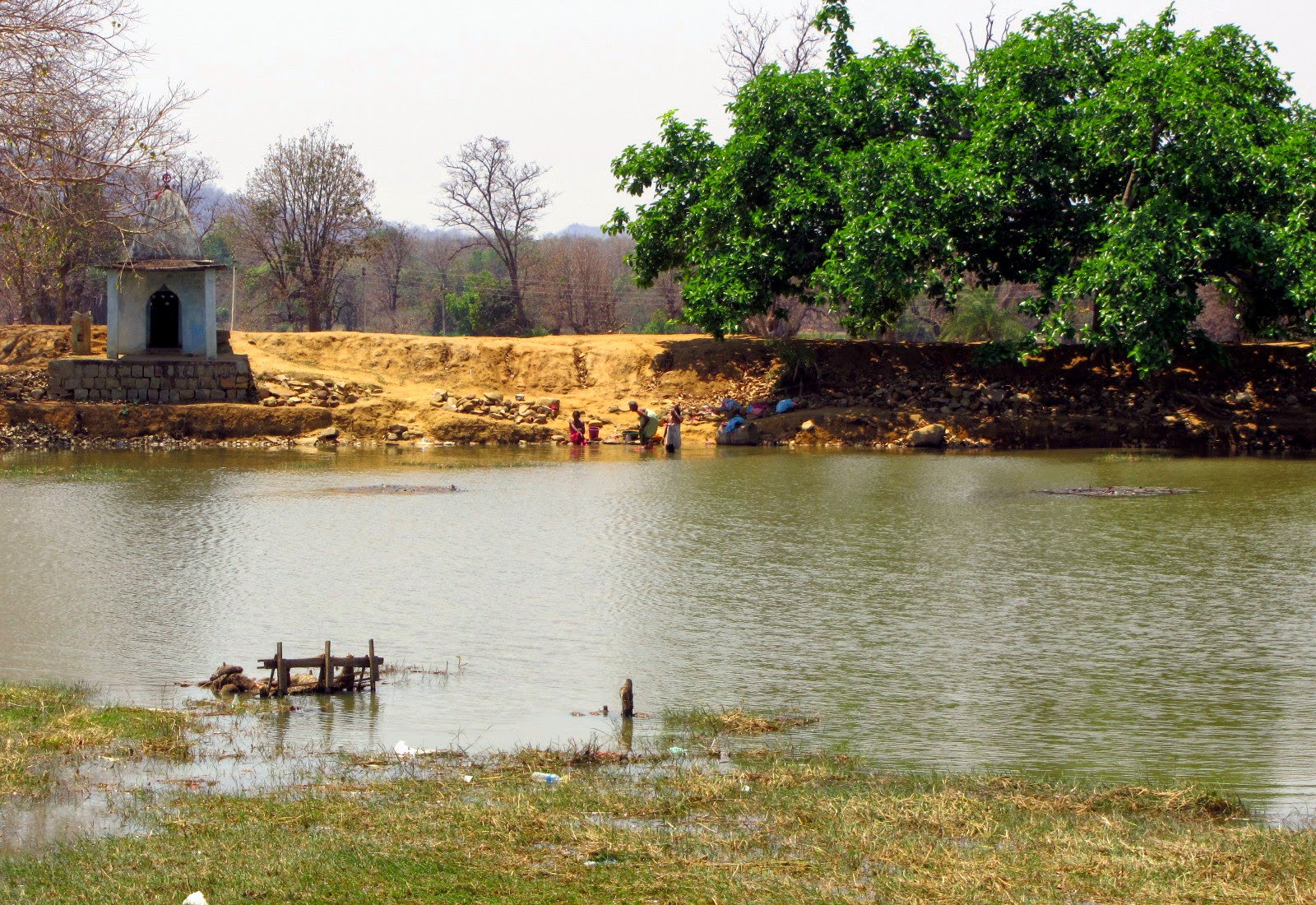
A typical community owned pond in a village. Villagers bathe there, as do - often times -their cattle, they wash their clothes and carry home pitchers of water to wash utensils and cook. The banks are usually where they squat on to relieve themselves.The tiny structure is the shrine of the patron god of the village


We were waiting. The house had a neat courtyard, 3 rooms, a nice little veranda and a cowshed. I walked around a bit, peeped here, peeped there. I could see no toilet.

We had eaten a rather large breakfast in the morning at Bhan Didi’s (the activist) place because it was going to be a long day, and I also drank a large glass of chai. Now, I was feeling the pressure on my bladder. I needed to go, urinate. But, there was no place to go.